
Regenerative Farming KPIs for Aromatic Crops: Beyond Organic in India
Regenerative farming for aromatic crops goes beyond organic. At Yathaavat Solutions, we track KPIs like soil carbon, water efficiency, biodiversity, and farmer income uplift. With real stories of Basil, Vetiver, and Chamomile farmers, we are building India’s future in sustainable essential oils — traceable, transparent, and transformative.
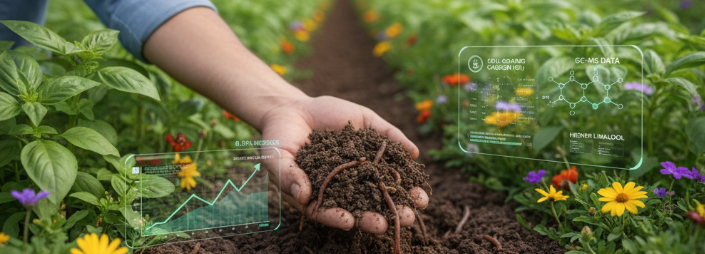

India has always been the land of aromas—from the sacred Tulsi (Holy Basil) grown in courtyards to the world-famous Vetiver (Khus) roots distilled in Uttar Pradesh. But in recent years, the global demand for natural and pure essential oils has transformed how aromatic crops are cultivated.
While organic certification is important, buyers across Europe, USA, and Asia are now asking a deeper question: What impact does your farming have on soil, water, biodiversity, and community?
This is where Regenerative Farming KPIs (Key Performance Indicators) come into play. At Yathaavat Solutions, working with our farmer clusters, we are not just focusing on natural practices but building an ecosystem to understand real impact.
What is Regenerative Farming for Aromatic Crops?
Regenerative farming goes beyond avoiding chemicals. It is about restoring soil health, increasing biodiversity, conserving water, and empowering farmers while still producing high-quality essential oils.
For aromatic crops like Lemongrass, Sweet Basil, Vetiver, Citronella, Mints, Chamomile, Wild Marigold and Geranium, regenerative practices are especially important because:
- These crops are long-cycle and resource-intensive.
- They are cultivated in rural clusters where water scarcity and soil degradation are real challenges.
- International buyers want traceability and sustainability.
Key Regenerative Farming KPIs
At Yathaavat, we track the following KPIs with our farmer clusters:
1. Soil Organic Carbon (SOC) %
Healthy soil = healthy oils.
- Target: Increase SOC by 0.1–0.2% annually through composting, mulching, and biochar.
- Example: In our Basil cluster in Madhya Pradesh, farmers applying mulched residues from distillation have already improved SOC levels by 0.15% in 18 months.
2. Water Use Efficiency (Litres/kg oil)
Essential oil distillation consumes water for steam.
- Traditional usage: 1500–2000 litres per kg oil.
- With water recycling at cluster units: Reduced to 600–800 litres per kg oil.
- KPI Goal: >50% reduction.
3. Biodiversity Index
This is a measure of how many species (plants, insects, birds) thrive around aromatic farms.
- Basil and Vetiver intercropped with pulses attract pollinators.
- Lemongrass borders act as natural pest repellents, reducing the need for pesticides.
- KPI Goal: Increase biodiversity score year-on-year.
4. Farmer Income Uplift (%)
Regenerative practices are sustainable only if farmers earn more.
- Hydrosol commercialization → ~10% income.
- Biomass for compost & mulching → savings on fertilizers.
- Biomass for boiler fuel → savings on firewood.
- KPI Goal: Minimum 10% uplift in net farmer income annually.
5. Traceability & Transparency
Every oil drum from Yathaavat is linked with:
- Farmer cluster
- Cultivation - Harvesting - Distillation window.
- GC-MS & COA data.
- Storage → Packaging to Dispatch.
This builds buyer trust and confidence.
Real Stories from India
-
Story 1: Sweet Basil in Madhya Pradesh Heavy rains in 2025 delayed Basil harvesting. Farmers feared losses. By applying distillation residues as mulch, they not only saved moisture but also improved soil fertility for the next cycle. The GC-MS results showed Basil oil with higher linalool content, fetching premium prices.
-
Story 2: Vetiver Roots in Uttar Pradesh A cluster of farmers replaced firewood with used vetiver roots as boiler fuel. The result was a 10% savings in distillation costs and lower carbon emissions. The same farmers also converted leftover biomass into biochar, improving soil health.
-
Story 3: Chamomile in Uttar Pradesh Chamomile (Blue Gold) is gaining demand globally. Farmers used drip irrigation and water recycling during distillation. The outcome was a 50% water savings, higher flower yields, and international buyers keen to source from this cluster.
Why Buyers Care About Regenerative KPIs
- Regulatory Compliance → Demands strict source-level data.
- Consumer Demand → Global wellness brands want sustainable origin stories.
- Risk Reduction → Better traceability reduces supply chain risks.
- Brand Value → Sustainability adds a premium position.
At Yathaavat, buyers not only get oils but also regenerative farming information wherever possible.
Yathaavat’s Commitment
- Training 500+ farmers in bio-inputs, composting, and intercropping.
- Rolling out QR traceability by 2026.
- Partnering with scientists at CSIR-CIMAP, NBRI for continuous innovation.
- Ensuring that every oil delivered has a farm-to-bottle regenerative story.
Conclusion
The future of India’s essential oils lies beyond organic. Regenerative farming KPIs will define the global competitiveness of our aromatic crops. At Yathaavat Solutions, we believe in co-creating this future—where farmers earn more, buyers trust more, and the planet breathes easier.
Every drop of oil we produce is not just pure—it carries a story of soil, water, biodiversity, carbon, and farmer empowerment.