How to Calculate Essential Oil Yield from Plant Biomass
Use simple formulas to estimate essential oil recovery from biomass, understand wet-versus-dry yield, and compare theoretical and actual output.
The most important unit is the biomass basis
Essential oil yield is often presented as a percentage, but a percentage alone is incomplete. You must know whether it refers to fresh plant mass, air-dried mass, oven-dried mass or the mass of a particular plant part. A leaf oil yield reported on a dry basis cannot be compared directly with a fresh-herbage yield. Roots, flowers, seeds and leaves also behave differently during handling and extraction.
Start every calculation with four recorded facts: botanical species and plant part, biomass mass, moisture or drying condition, and recovered oil amount. Record whether the oil is measured in grams, kilograms or milliliters. Only then should you calculate or compare yields.
Formula 1: recovery on a fresh-mass basis
Oil recovery percentage by mass = (mass of recovered essential oil / fresh biomass mass) x 100.
Imagine a batch using 1,200 kg of fresh aromatic herbage. After complete separation and measurement, 3.6 kg of essential oil is recovered. The observed recovery is (3.6 / 1,200) x 100 = 0.30%. This is an invented teaching example, not a published standard for any crop. It assumes that the input and output masses were both measured correctly.
When oil has been measured only by volume, do not substitute liters for kilograms. Use a measured or appropriately referenced oil density at a stated temperature to convert volume to mass. If density is unknown, report the volume separately and avoid a mass percentage.
Formula 2: recovery on a dry-mass basis
Oil recovery percentage by dry mass = (recovered oil mass / dry biomass mass) x 100. If the original 1,200 kg batch contained 75% moisture by mass, its approximate dry matter would be 300 kg, assuming the moisture measurement was representative. With 3.6 kg of recovered oil, the corresponding dry-mass recovery would be 1.20%.
The fresh and dry percentages differ because the denominators differ, not because more oil was created. Moisture determinations themselves have uncertainty, and drying may cause loss of volatile compounds. Always explain the sampling method and treatment of drying losses.
Formula 3: predict crop output from acreage
Projected oil (kg) = projected harvest biomass (kg) x assumed recoverable oil fraction. For multiple harvests, calculate every cut independently and sum the results. To estimate per-acre output, divide the summed output by the harvested acreage; if the harvested area changes, track it for each cut.
A planning calculator should accept low, expected and high biomass and recovery scenarios. Multiplying the high end of every uncertain variable will produce an unlikely headline figure; it is better to show a range and name the assumptions clearly.
Measured recovery versus laboratory potential
A laboratory analysis may describe the volatile-oil content of a sample under a particular method, but a commercial distillation unit may recover a different fraction. Material condition, chopping, load size, steam distribution, condenser performance, separation losses and operating time all affect the result. Process efficiency should therefore be reported separately from raw-material potential.
For sound comparisons, keep records of the biomass origin, harvest date, time before distillation, load mass, process duration, heating conditions and oil collected. A simple batch log can reveal whether changes in yield are coming from farming, feedstock handling or distillation.
Common mistakes that inflate expected output
Confusing fresh and dry basis is the largest arithmetic error. Other mistakes include mixing oil volume and mass, assuming each harvest matches the first, ignoring non-distillable biomass, using a botanical average as a contractual guarantee, and forgetting rejected or contaminated batches.
To prevent errors, make each calculation transparent: show inputs, units, formula, output and a confidence label. Explain whether the result is measured, modeled or sourced from external literature. If the user adjusts one assumption, recalculate all dependent values consistently.
Turning a yield number into a business decision
Oil yield is only one part of the business. For commercial planning, combine accepted oil quantity with the net realized selling price, then deduct full cultivation, processing, testing and distribution costs. Separate gross revenue from contribution and net profit. Repeat the calculation at several prices to understand sensitivity.
A good essential-oil calculator supports decisions; it does not replace a field trial, quality report or commercial quotation. The most useful long-term benchmark is the verified history of the same farm, cultivar and still.
Frequently asked questions
Can I calculate oil yield from acreage alone? Only as an estimate. You need assumptions about biomass per area and oil recovery, ideally derived from local records.
Why is the dry-mass percentage higher than the fresh-mass percentage? Dry mass removes water from the denominator. It does not imply that more oil was recovered.
Should I use liters or kilograms? For weight-percent recovery, use mass consistently; convert measured volume using an appropriate density if necessary.
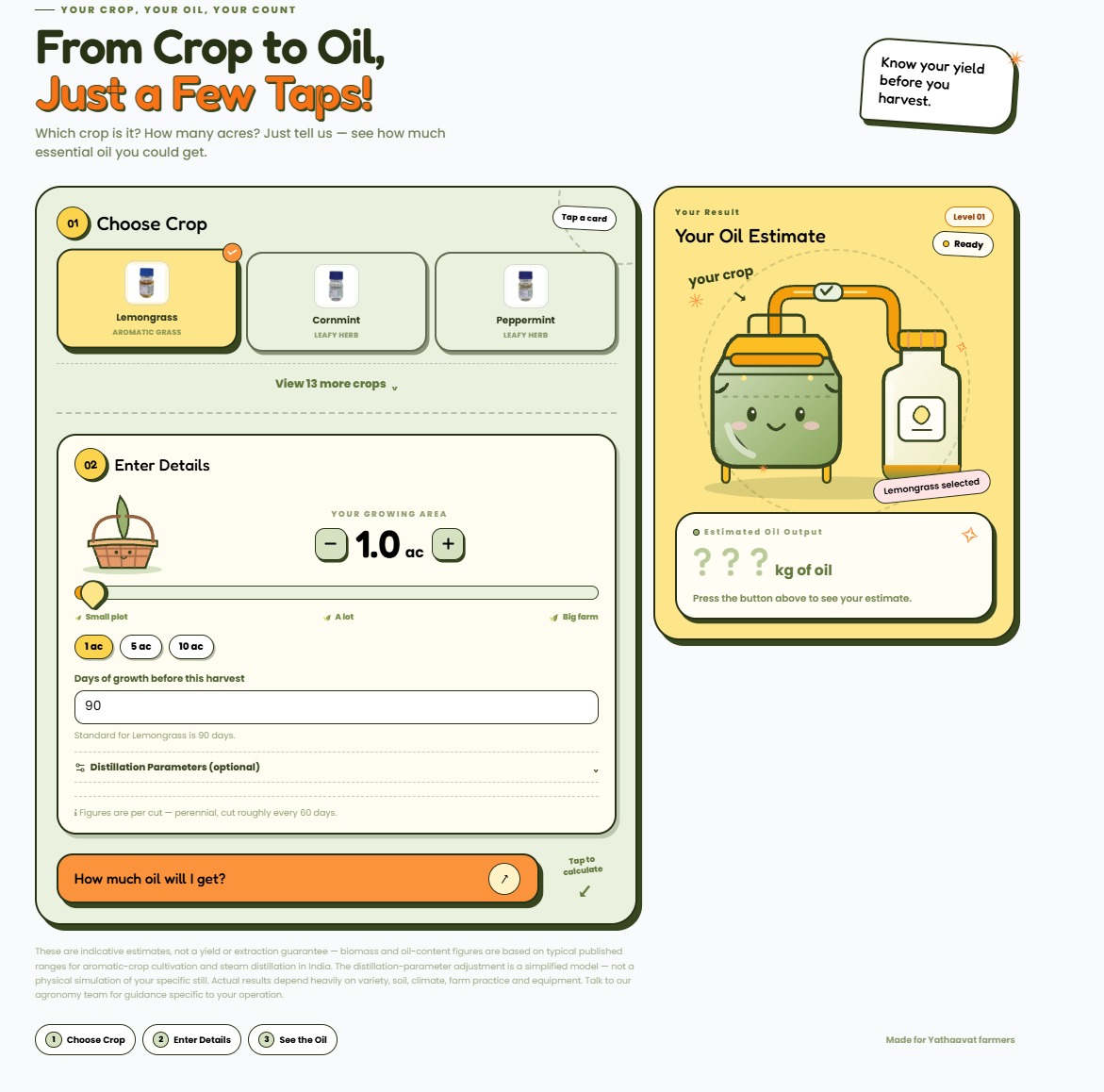
Use the Yathaavat biomass-to-oil calculator as a planning aid, then validate its assumptions against your own distillation records. Visit
Related Articles
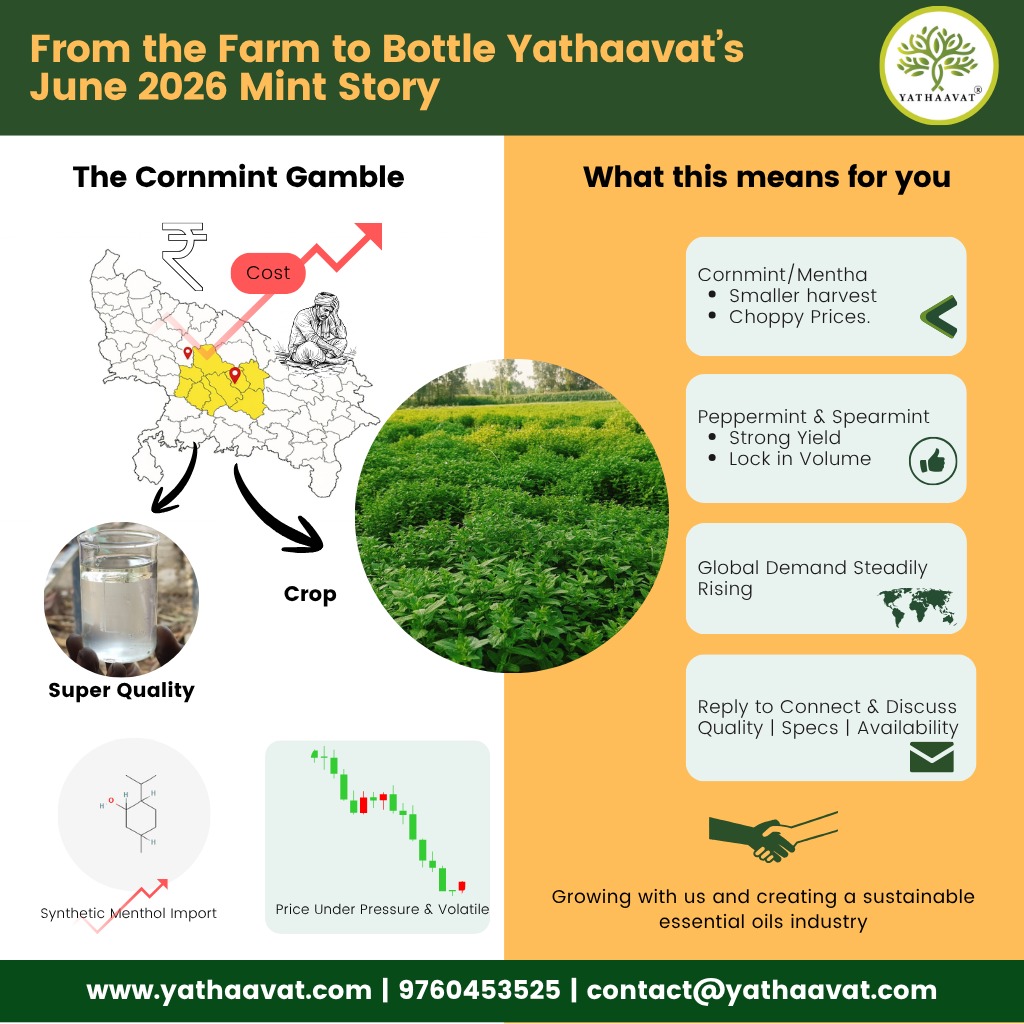
From Farm to Bottle: Mint Story | Jun 2026
India's 2026 mint season has brought significant changes to the essential oils market. Reduced Cornmint cultivation, strong Peppermint and Spearmint production, and shifting farmer preferences are reshaping supply and pricing. In this market update, Yathaavat Aromatics shares on-ground insights, crop trends, and what these developments mean for buyers, exporters, and the global essential oils industry.

The Story of Sweet Basil Essential Oil - From Bharat’s Fields to the World
Experience the journey of Sweet Basil Essential Oil, from the sun-drenched fields of Bharat to the bottle. This oil tells a story of dedicated farmers, sustainable practices, and the magic of distillation. At Yathaavat Aromatics, every drop is a promise of purity, transparency, and a fair livelihood for our farmers. It’s the essence of nature, distilled with human spirit.